Controller Plugin Entry
Plugin Entry Module
This module serves as the plugin entry point, similar to a program main function. You can define multiple entry modules and priorities inside a plugin; when the controller loads them, it loads them in priority order.
Entry module loading is divided into several stages:
- Validation: This stage mainly checks whether the plugin is valid and can be loaded, including whether the package structure is correct and whether the version meets requirements.
- Authorization validation: Authorization is checked before plugin initialization. The plugin developer decides whether authorization is required. If secondary authorization is required, the plugin initialization flow continues only after authorization passes.
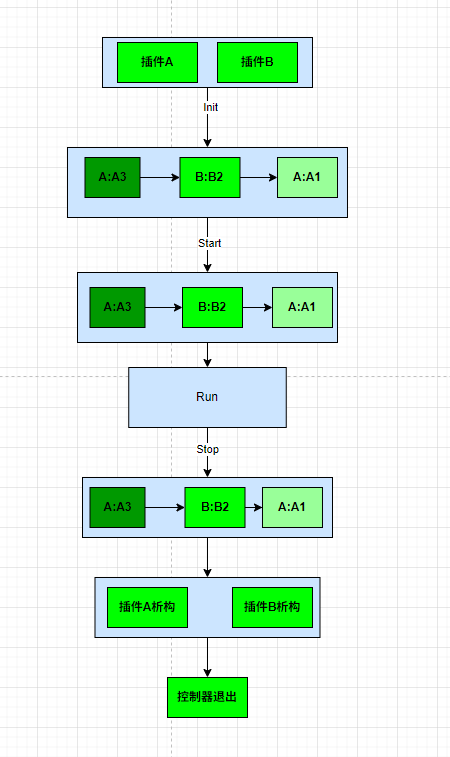
- Init stage: After all plugins are constructed, initialization begins. Entry modules are sorted by priority; higher-priority modules run first, and the next module runs only after the current one finishes. Execution order among modules with the same priority is not fixed.
- Start stage: After all plugin entry modules finish Init, the Start stage runs with the same priority-based order as Init. Plugin logic can run in Start.
- Stop stage: Before the controller exits, this stage cleans up resources, again following module priority order.
- Destruction stage: Each entry module is destroyed; destruction order is not fixed. If resource cleanup depends on other modules, perform it in Stop according to priority.
Controller Plugin validation stage:
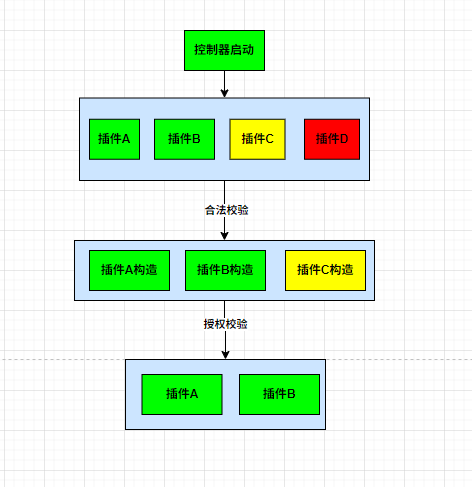
Authorization validation:
A plugin may require authorization before use. If authorization is required, each machine must be authorized individually. Contact Rokae to obtain per-machine authorization codes.
Authorization is controlled in src/launch/authorize.cpp.
Setting this to true enables authorization validation. Validation is disabled by default.
EXPORT const bool plugin_need_authorize = false;
Controller Plugin initialization flow
Usage Example
#include "launch_api.hpp"

// 1. Inherit LaunchAPI and implement Init, Start, and Stop
class Launch:public xcore_api::launch::LaunchAPI{
public:
    explicit Launch();
    virtual void Init() override;
    virtual void Start() override;
    virtual void Stop() override;
    virtual ~Launch();
};
// 2. Declare as an entry module in the cpp file
LAUNCH_MODULE_PRIORITY(Launch,0)// with priority
LAUNCH_MODULE(Launch) // without priority
// 3. Implement Init, Start, and Stop
This example is implemented in the plugin src/launch module. Users only need to inject their own functions at the appropriate stages.